





























Return to Office in Canada 2026: What 7 Million Employee Responses Reveal
A Source Office Furniture study, based on proprietary AskPolly research conducted in March 2026. Analysis of 31 questions and more than 7 million responses from Canadian employees on the realities of returning to the office.
Methodology
This report is based on proprietary research commissioned by Source Office Furniture and conducted via the AskPolly platform in March 2026. The study captured more than 7 million responses across 31 questions from Canadian employees nationwide. Sample sizes for individual questions are noted alongside each finding throughout this report. Where external data is referenced, sources are linked directly. Full methodology and dataset available on request.
The RTO Shift in Canada: Where We Are
Over the last 18 months, the return-to-office conversation in Canada has moved from recommendation to policy. In September 2024, the federal government required public servants in the office at least three days a week — a number set to rise to four days a week from July 2026. The big banks in Canada have tightened their hybrid models in parallel, pushing employees to four or five office days a week.
A lot has shifted in the three years since the pandemic. Many Canadians moved farther from city centres to keep up with the cost of living, while employers are stuck between two worlds — asking employees to come in more often, without upgrading the offices they're coming back to.
This study, commissioned by Source Office Furniture, set out to capture what Canadian employees think about this trade. Not what their employers or leadership teams assume. Not what American surveys extrapolate north of the border. Across 31 questions and more than 7 million recorded responses from Canadian employees, one signal comes through louder than any other:
That distinction matters.
The resistance isn't ideological — it's practical, rooted in the everyday concerns Canadians are facing.
Key Findings
The five-day office week is losing ground. Across 438,942 responses, nearly three times as many Canadian employees said they don't want to be in the office five days a week as those who do.
It's not the office people resist, it's how it feels today. A strong 97.5% said they'd be more open to returning if the workspace itself was improved.
Ergonomics isn't a "nice to have" anymore. 97.7% believe better ergonomic setups would help them work more efficiently and feel less drained.
The office now plays a role in career decisions. 98.2% of respondents say the quality of the workplace factors into whether they take or stay in a job.
The commute is the biggest hurdle. With more than 165,000 mentions, commuting is the top reason Canadian employees hesitate to return.
Fix the office first, then mandate the return. 92.9% believe companies should create a comfortable, well-equipped space before requiring people back.
The basics matter more than ever. 98.5% want better in-office tools and amenities — good coffee, reliable high-speed internet, ergonomic chairs, and quiet spaces to focus.
Better spaces would genuinely bring people back. There's near-universal agreement that improving the office environment would increase willingness to return.
Current State of Return to Office in Canada
Canada is in the middle of a cultural shift most offices weren't built for. The data confirms what employees already feel: spending five days a week in the office is no longer the norm.
When 438,942 Canadian employees weighed in on how often they go to the office, only 24.4% reported being in five days a week — meaning roughly three out of four work in some form of hybrid or flexible arrangement.
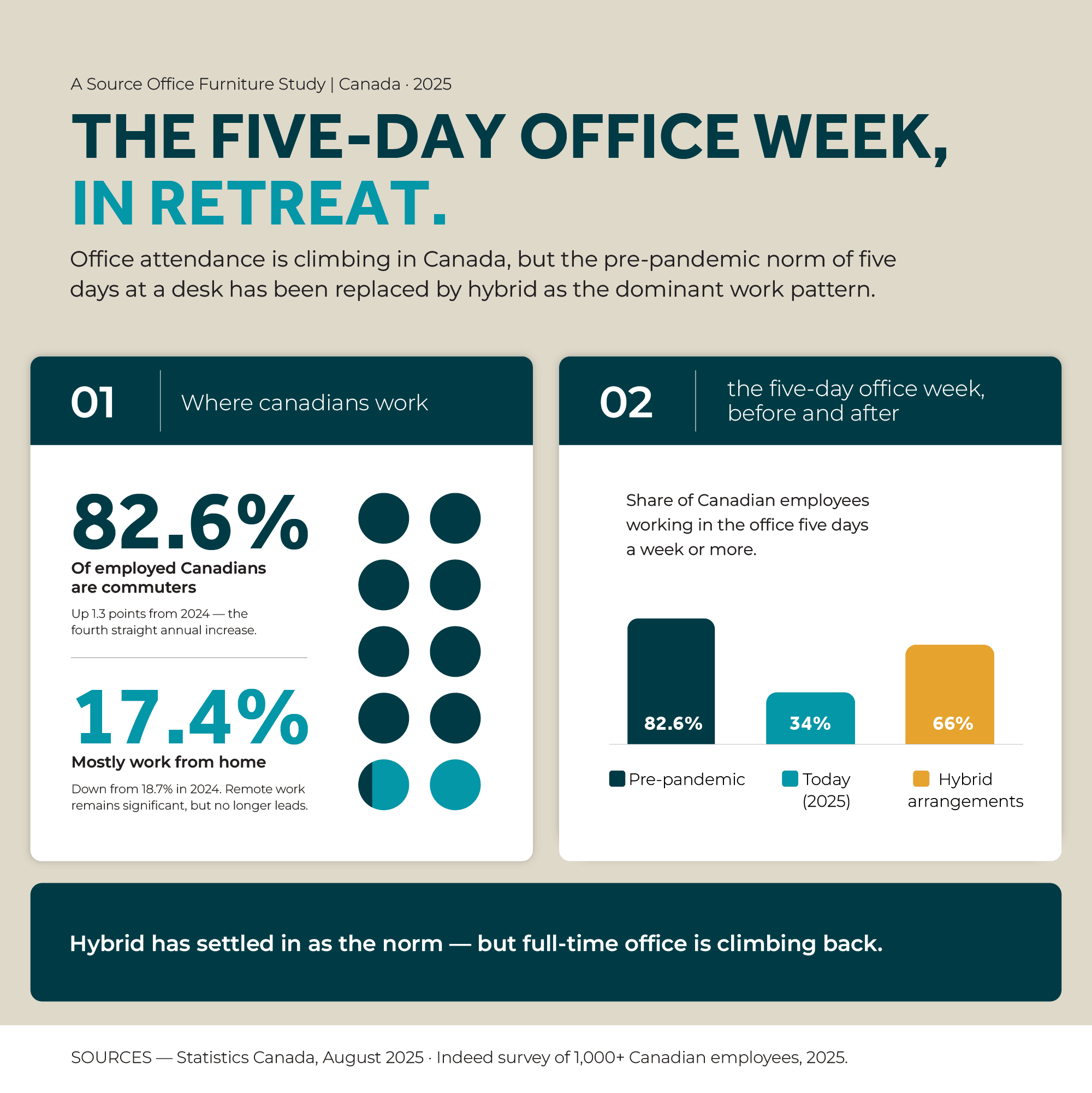
The five-day office week, in retreat. Sources: Statistics Canada (May 2025); Indeed survey via Benefits Canada (2025).
In Canada, office attendance has been trending upward. Recent data points to a clear shift back toward in-person work:
- 82.6% of employed Canadians were commuters as of May 2025, up 1.3 percentage points from the year before (Statistics Canada)
- 17.4% worked mostly from home, down from 18.7% in 2024 (Statistics Canada)
- 34% of Canadian employees now work in the office five days a week or more — a sharp drop from 83% before the pandemic (Indeed survey via Benefits Canada)
- Nearly two-thirds of employees are in a hybrid arrangement, averaging about three in-office days per week (Indeed)
Together, these numbers suggest hybrid work has settled in as the dominant model — but full-time office attendance is steadily climbing back.
The pattern: Canadian employees have already adjusted to distributed, flexible work. Blanket RTO mandates that ignore this shift face predictable resistance — not because employees are opposed to offices, but because the offices they're being asked to return to haven't kept pace with how the work is actually done.
Employee Sentiment Toward RTO
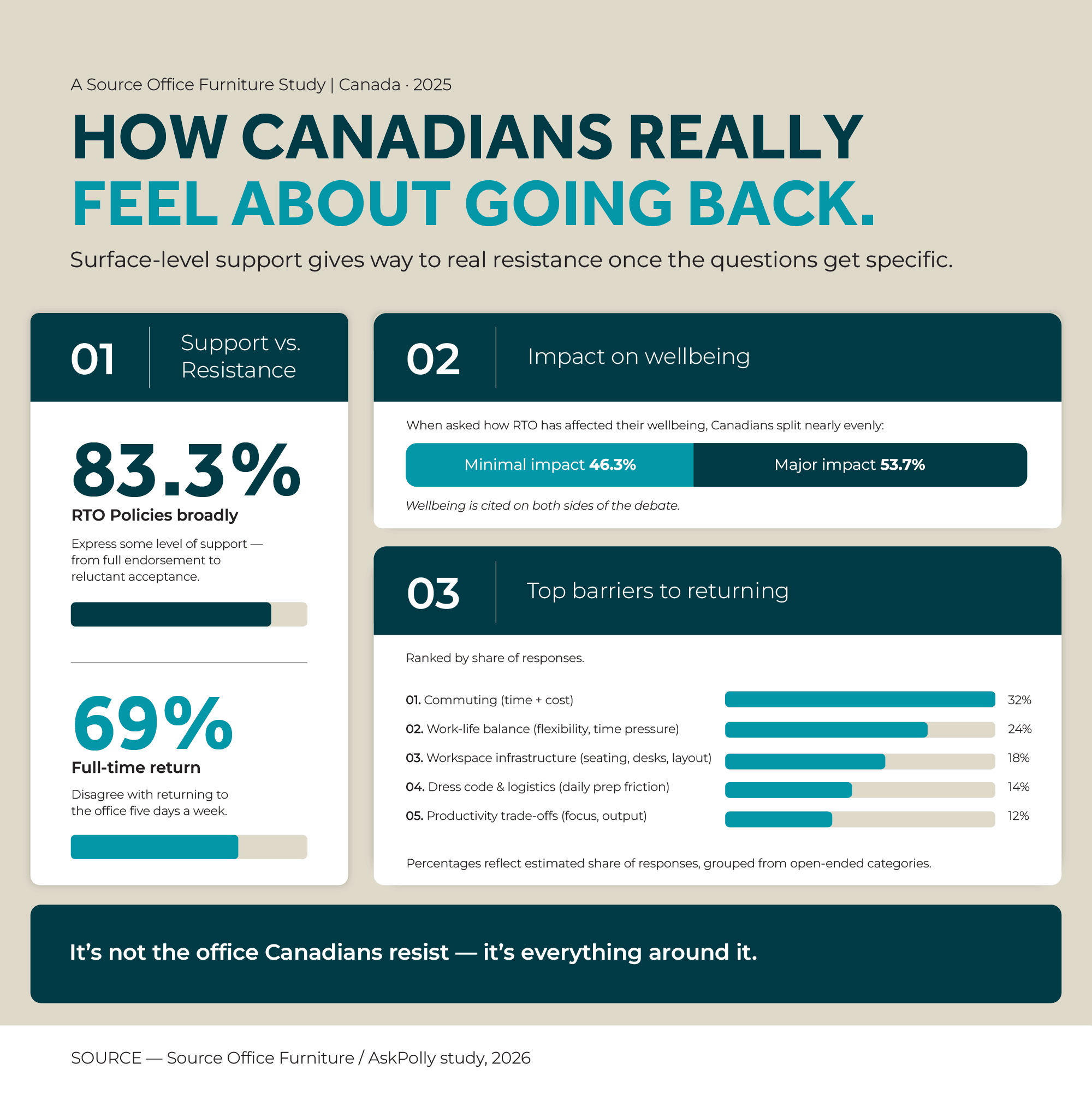
When asked directly about return-to-office policies, only 16.7% of Canadian employees rejected them outright. The remaining 83.3% expressed varying degrees of support — from full endorsement to reluctant acceptance.
But that surface-level support breaks down quickly under closer questions. When asked how RTO has affected their overall wellbeing, the split was nearly even:
- Minimal impact: 46.3%
- Major impact: 53.7%
That near-tie is the real story of Canadian RTO sentiment. Wellbeing is cited on both sides of the debate. Some employees feel better supported by the structure and social connection of the office. Others see their wellbeing suffering because of the commute, office conditions, and commitments at home.
The split sharpens further when employees are asked specifically about returning to the office full-time. From 357,773 responses:
- Agree they should return full-time: 31%
- Disagree with returning full-time: 69%
What's actually driving the resistance
When asked what they dislike most about returning to the office, the response volume was the highest of any question in the study — 953,176 total mentions. The standout finding: dress code alone drew 458,171 mentions, nearly half of all responses. It's a useful reminder that everyday frictions, not abstract policy debates, shape how Canadian employees experience the return.
A separate question asked employees to identify their top barrier to returning. Ranked by share of responses:
- Commuting (time + cost) — 32%
- Work-life balance — 24%
- Workspace infrastructure (seating, desk space, layout) — 18%
- Dress code and day-to-day logistics — 14%
- Productivity trade-offs — 12%
Percentages reflect estimated share of responses, grouped from open-ended categories. Full methodology available on request.
Regional Breakdown: How RTO Sentiment Varies by City
Return-to-office sentiment in Canada isn't uniform. It varies sharply by city — shaped by commute times, labour laws, housing costs, and dominant industries.
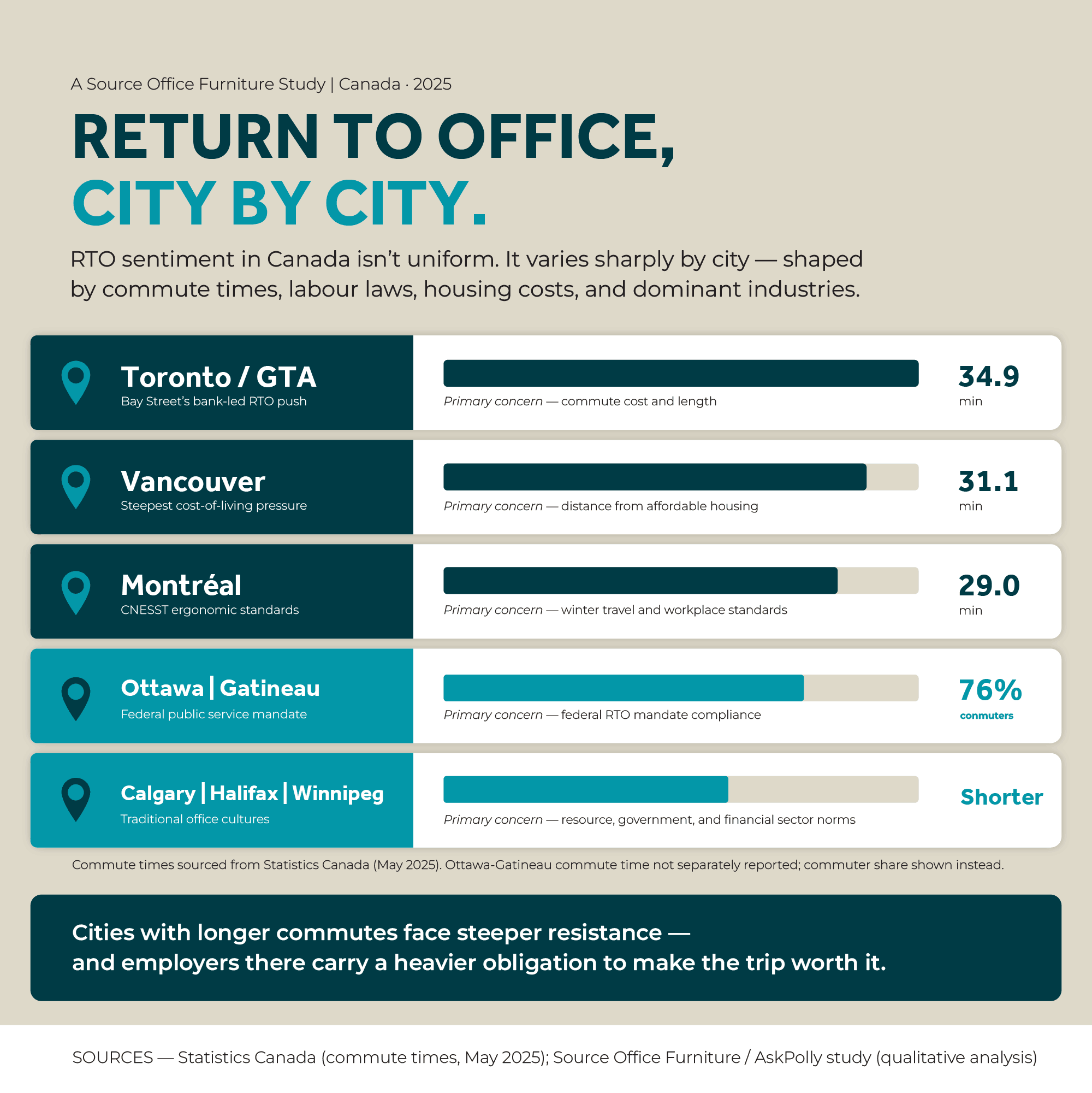
Average one-way commute times across Canada's major cities, paired with the primary RTO concern shaping each region. Sources: Statistics Canada (May 2025); Source Office Furniture study, 2026.
Toronto and the GTA face the longest commutes in the country. The Financial District's concentration of big banks means Bay Street has led the push to four- and five-day mandates, with major banks tightening hybrid rules through 2024-2025. GTA commuters are the group most likely to cite cost of commuting as a resistance factor — matching the study's commuting-barrier finding directly.
Montréal operates under Quebec's distinct labour laws and workplace culture. The CNESST's ergonomic standards mean employees in Quebec know exactly what equipment they have the right to receive from their employers. Commuting via the metro system tends to be faster than Toronto's, but winter travel introduces its own challenges.
Vancouver has among the steepest cost-of-living pressures in the country, pushing employees toward Surrey, Coquitlam, Langley, and the Fraser Valley. That means longer commutes into downtown offices — and a workforce especially sensitive to the "why am I commuting for this?" question when the office doesn't offer a clear upgrade over home.
Calgary, Ottawa, Halifax, and Winnipeg — Canada's mid-sized cities — tend to have shorter average commutes but more traditional office cultures, particularly in resource, government, and financial sectors. The federal public service mandate affects Ottawa most directly, with downstream effects on every office in the capital region.
The regional takeaway: Cities with longer commutes face steeper resistance to full-time mandates, and employers in those markets carry a heavier obligation to make the in-office experience worth the trip.
Connection to Employee Wellbeing
Returning to the office has had a genuinely mixed effect on Canadian employees' wellbeing.
For many employees, the office environment offers structure and focus — driving positive wellbeing outcomes. For others, lengthy commutes and distracting environments add measurable strain.
Across the responses, the same wellbeing themes appear repeatedly: mental health, commute stress, the quality of the office environment, flexibility, work-life balance, job satisfaction, and social interaction. The office environment is just one of many factors that shape wellbeing alongside commute, home life, and personal circumstances. But it's one of the few employers can directly influence, which is why it's a practical lever for making RTO smoother.
Flexibility plays a major role in wellbeing regardless of work model. Employees who struggle most often cite a lack of flexibility, long commutes, and poorly equipped workplaces. Those who feel best supported tend to work in flexible environments with the equipment and settings they need.
Factors Employees Prefer in the Workplace
What do Canadians actually want from an office when they show up? The study spread this question across four angles — amenities, furniture, comfort factors, and tools — with remarkably consistent findings.
The experience of working in an office is shaped, more than anything, by the comfort and equipment available to employees. The essentials show up clearly in the data: fast internet, meeting rooms, soundproof spaces, and adequate lighting. When asked what improvements would matter most, employees pointed to ergonomic office chairs, noise-cancelling headphones, and better cable management.
Beyond the basics, employees want resources that make day-to-day work easier — coffee stations, whiteboards, collaborative tools, and flexible spaces that can shift between focus and teamwork. Comfort itself is shaped by a stack of factors working together: lighting, air quality, temperature, layout, and overall atmosphere.
The pattern is consistent across every angle the study measured. The best workplaces share the same qualities — good lighting, fresh air, comfortable chairs, a quiet atmosphere, reliable internet, and flexibility in how the space is used.
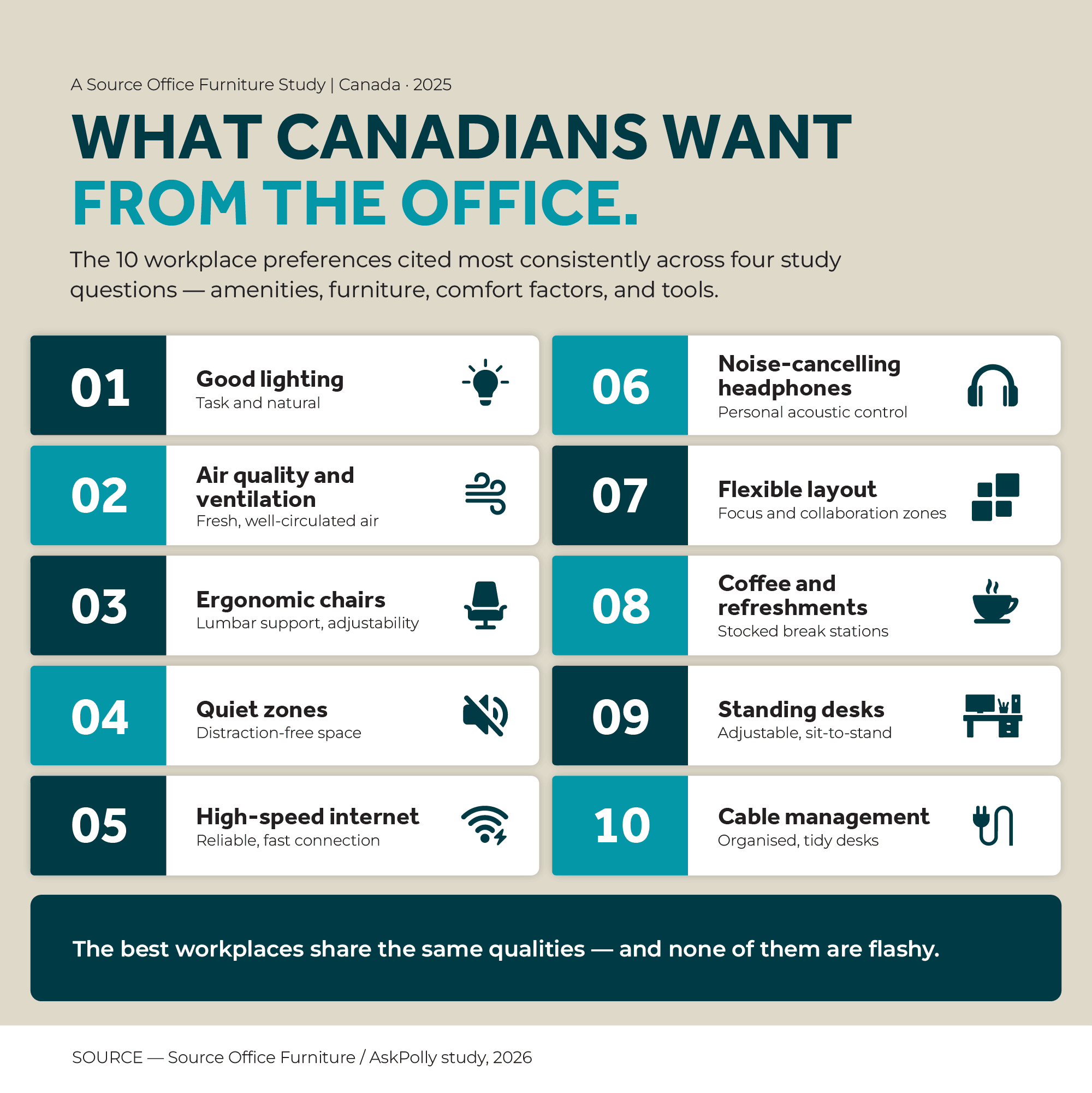
Top 10 workplace preferences
- Good lighting (both task and natural)
- Air quality and ventilation
- Ergonomic chairs
- Quiet zones and distraction-free space
- High-speed internet
- Noise-cancelling headphones
- Flexible layout (zones for focus vs. collaboration)
- Coffee and refreshment stations
- Standing desks and adjustable surfaces
- Cable management and organised desks
Factors That Impact Productivity
Productivity shows up in this dataset as a practical equation: environment + tools + comfort + commute = output.
When Canadian employees were asked directly how office furniture quality affects their productivity, 97.7% agreed that better ergonomics meaningfully improves output, with only 2.3% disagreeing. Accessibility features topped the named responses.
When asked what would most improve their workday, Canadian employees overwhelmingly named ergonomic furniture. Of 51,526 responses, more than 25,000 said better office chairs would improve productivity and reduce fatigue — with over 17,000 strongly agreeing. Beyond chairs, 12,000+ employees specifically called out ergonomic accessories: standing desks, lumbar support, adjustable desks, monitor stands, and footrests.
Productivity drivers, ranked by strength of signal
- Ergonomic seating (chairs, lumbar support)
- Distraction-free space (quiet zones, acoustic treatment)
- Lighting (task + natural)
- Air quality and temperature control
- Standing desks and adjustable surfaces
- Cable management and desk organisation
- Accessible tools (high-speed internet, updated tech)
- Collaboration infrastructure (whiteboards, meeting rooms)
- Health and wellness programs
- Commute structure (shorter commute = more focused hours)
Office Furniture and Productivity
The furniture question is where Canadian employees are most unified. The study approached furniture from four different angles, and the findings were strikingly consistent across all of them: Canadian employees agree, almost universally, that furniture has a real impact on their work.
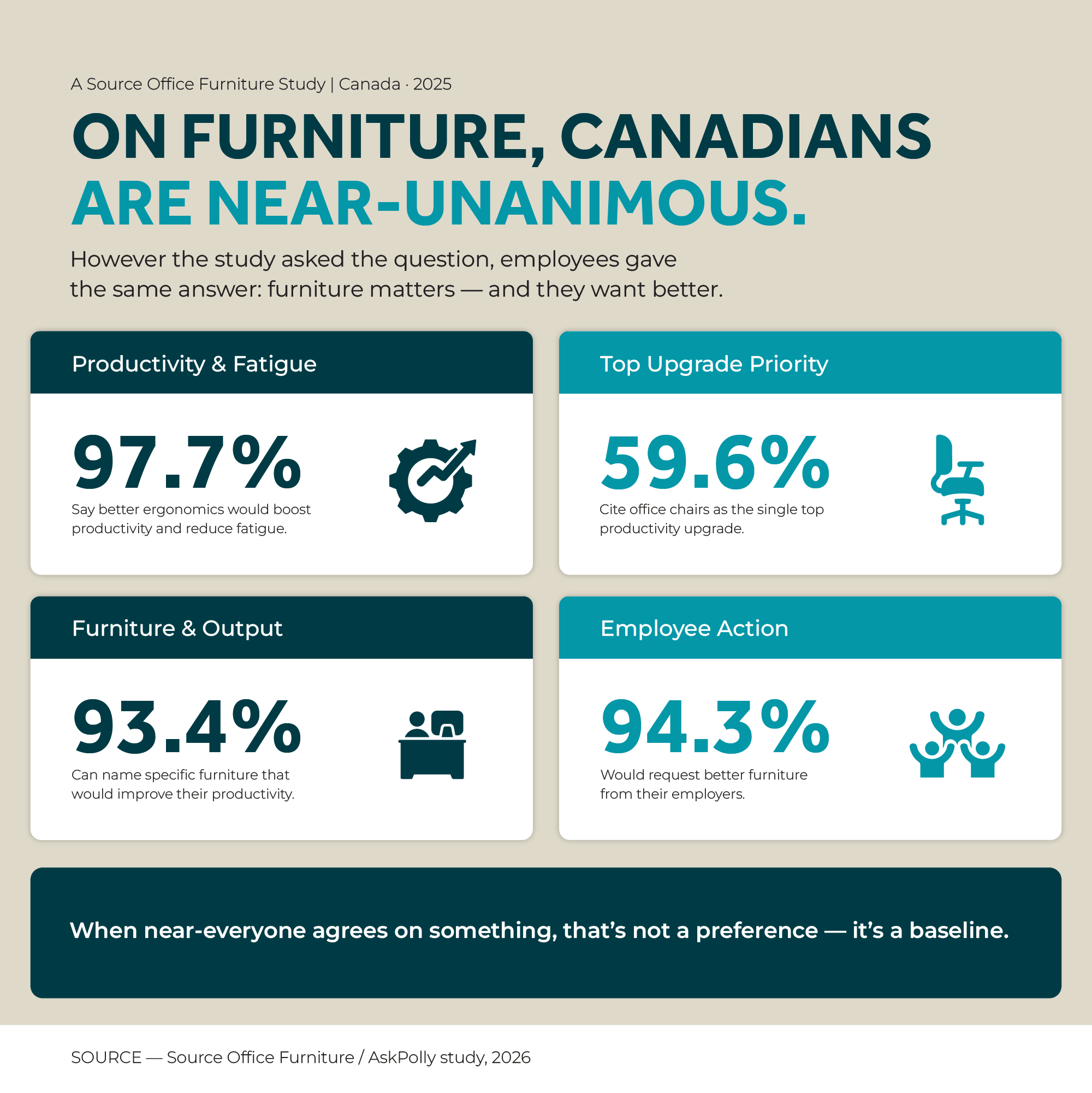
Impact of proper setup on focus, comfort, and output
Canadian employees describe a consistent before-and-after:
- Without ergonomic support: back pain, fatigue, and shorter productive hours
- With ergonomic support: longer focus, less end-of-day fatigue, and a stronger willingness to come in
The productivity implication is straightforward. With 97.7% of employees agreeing that better ergonomics would reduce fatigue, and reduced fatigue translating directly to better output in knowledge work, the math favours seating upgrades over surface-level perks. Employers investing in flashy amenities while leaving chairs untouched are spending in the wrong order.
Workplace Ergonomics: The Discomfort Gap
When asked about physical discomfort at work, Canadian employees consistently named the same culprits: neck stiffness, headaches, fatigue, eye strain, wrist discomfort, and back pain.
When we talk about returning to the office, the conversation often gets framed around policy. But the reality feels much more personal. It's about the chair you sit in for eight hours, the noise around you, the space you have (or don't), and how your body feels at the end of the day.
The data shows near-universal agreement on what helps people do their best work — and what gets in the way.
About 97% say their current office furniture is acceptable, but an even stronger 98% believe better ergonomics would directly improve their productivity. That same 98% say improved furniture would make returning to the office easier, showing just how central physical comfort is to the conversation.
It's not about flashy perks. Around 90% say simple, practical upgrades — better chairs, quieter spaces, and fewer distractions — would meaningfully improve their day. And 94% would actively ask their employers for better furniture or wellness support, reinforcing that this is a real, felt need.
The connection between comfort and performance is hard to ignore. 94% of employees say they feel a clear difference between working from home and the office, often pointing to back pain, neck strain, eye fatigue, and constant distractions. The pattern is simple: when the setup is poor, focus drops and fatigue sets in. When the setup works, people can focus longer, feel better, and get more done.
A well-equipped office with better seating would win on both fronts — and that's exactly the unmet opportunity the data points to.
Commuting Challenges
Commuting is the single biggest pressure point in the return-to-office conversation — and it's getting harder, not easier.
As housing costs have risen, more Canadians have moved farther from city centres to find affordable homes and a better quality of life. That shift has stretched commutes in both time and cost. What used to be a short trip is now a daily trade-off.
The data reflects this clearly: over 65% of responses point to commuting as a direct barrier to returning to the office, and roughly 1 in 3 employees specifically cite the cost. Whether it's transit fares running $400+ a month or fuel and parking adding up to $20–30 a day, the math doesn't favour the office.
It's not just about going back to the office — it's about what it takes to get there.
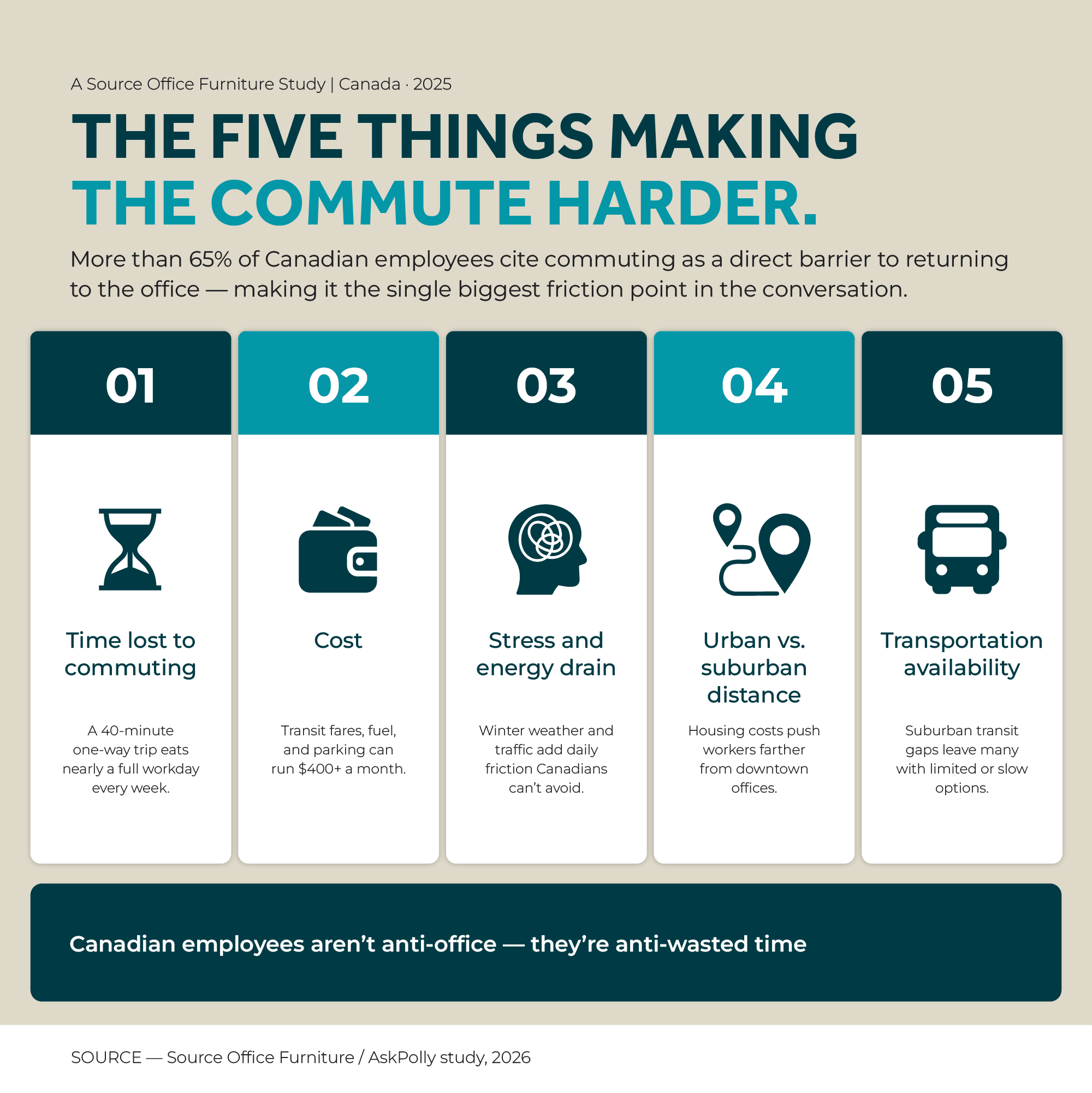
Canadian employees aren't anti-office. They're anti-wasted time. Offices that justify the trip with better chairs, better acoustics, and proper amenities make the commute arithmetic more palatable.
Employer Responsibility Before RTO
Canadians are clear about what they expect before being asked to return to the office. About 93% believe employers have a real responsibility to create a comfortable, supportive workplace before making RTO mandatory.
A big part of that comes down to feeling heard. Many employees say employers should respect employee choice and involve them in decisions, not just announce mandates. At the same time, there's an expectation to get the basics right — especially ergonomic furniture and a workspace that actually supports day-to-day work.
In practical terms, the expectations are straightforward: comfortable, well-equipped workstations, quiet and functional spaces, good lighting and air quality, reliable tech, and access to wellness support. Flexibility around when and how people come in matters just as much.
More broadly, nearly 9 in 10 Canadians support efforts to improve office environments — especially when those efforts focus on flexibility and real investments in workspace quality.
When employers put in the effort first, employees are far more open to coming back.
When asked what employers should do before mandating a return:
- 62.5% said employers should consider employee choice
- 28.4% said employers should provide ergonomic furniture first
Pre-RTO employer checklist: what Canadian employees expect
- Ergonomic chairs for every workstation
- Adjustable (sit-stand) desks where feasible
- Quiet zones and acoustically treated focus spaces
- Functional meeting rooms with working tech
- High-speed internet
- Good task and ambient lighting
- Air quality and ventilation improvements
- Coffee and refreshment stations
- Wellness programs and mental health support
- Clear flexibility options around attendance and hours
- Consultation with employees before mandates take effect
Home vs. Office: A Side-by-Side Comparison
The home vs. office debate isn't black and white — it's a mix of trade-offs, and most Canadians see real value in both.
At home, about 88% of employees say comfort comes from control. Things like lighting, fewer distractions, flexible hours, and better work-life balance make a noticeable difference. Being able to adjust your space — temperature, noise, setup — goes a long way.
In the office, a similar share (around 89%) point to comfort too, but for different reasons. Better lighting, air quality, and access to proper workspaces stand out, along with the structure and energy of being around a team.
When it comes to what people actually enjoy about the office, many highlight having a more focused, distraction-free space, along with the benefits of routine, collaboration, and in-person connection.
Each setup has its strengths. The office works best for collaboration, structure, and access to tools and shared spaces. It also helps create a clearer boundary between work and home life. Home, on the other hand, wins on comfort and control — no commute, more flexibility, and a setup people can tailor to their needs.
The ideal isn't choosing one over the other. It's blending both — an office that delivers collaboration and structure without losing the comfort, flexibility, and focus people value at home.
Head-to-head: Home vs. Office
| Dimension | Home | Office |
|---|---|---|
| Commute time | Zero | 30+ min each way in GTA / Vancouver on average |
| Chair comfort | Often better (personal investment) | Varies widely by employer |
| Lighting | Often inconsistent | Generally better (natural + task) |
| Air quality | Depends on dwelling | Varies; often a complaint |
| Distractions | Family, domestic noise | Colleagues, office noise |
| Focus time | Higher with good boundaries | Higher with proper quiet zones |
| Collaboration | Harder | Much easier in person |
| Control over environment | High | Low |
| Cost to worker | Utilities | Commute, meals, wardrobe |
Conclusion: What the Data Actually Says
Across millions of responses, the message from Canadian employees is steady and hard to ignore.
This isn't about resisting the office. It's about redefining what the office needs to be.
Hybrid work has settled in as the norm. It's not a temporary phase or a leftover from the pandemic — it's how people now organize their work and lives. Trying to force a full return to old models doesn't just create friction; it misses how much expectations have shifted.
At the same time, employees aren't asking to stay home forever. What they're saying is simple: make the office worth it. When nearly everyone agrees that better setups — chairs, lighting, air quality, quieter spaces — would make returning easier, that's not a perk list. That's a baseline.
The data also makes something else clear: it's not really about location. It's about conditions. People do their best work in environments that support focus, comfort, and wellbeing — whether that's at home or in the office. When the office delivers on those, people show up more willingly.
Underlying all of this is a strong expectation of responsibility. Employees want to feel considered before decisions are made. They're asking for practical things — flexibility, better tools, wellness support — not abstract promises.
The real takeaway: this is a shared opportunity. Employees are clear about what they need to do their best work. Employers who listen and act on that before enforcing policies will see a very different response than those who don't.
Most Canadians aren't unreasonable. They'll come in for meaningful work, good collaboration, and a setup that supports them. When those pieces are in place, the conversation shifts from frustration to openness.